Part J · the document
What a Kirkwood roofing proposal should put in writing
Two proposals for the same roof can differ by thousands of dollars and describe completely different work, and you cannot tell which is which from the number at the bottom. These are the lines that make them comparable.
The permit and licensing block
Four of the sixteen are specific to a town that runs its own counter, and they go first because they are the ones nobody else asks for.
- Who pulls the permit, by name. The contractor, not the homeowner, unless there is a stated reason and you agree with it.
- Under which authority. The City of Kirkwood if the address is inside the city limits. If a proposal says "county" for a Kirkwood address, ask why before anything else.
- Whether the permit fee is in the price or extra. Either answer is acceptable. An unstated answer is not.
- What happens at inspection. Who attends, and what the schedule does if the inspection does not pass first time.
The scope block
- Tear off to the deck, or a layover. Stated explicitly, and the number of existing layers if known.
- Decking price, as a number. Per sheet or per board, with the method for counting and documenting it. This is the single most important line in the document.
- Underlayment. What type, over what area.
- Ice and water protection. Where it goes: eaves, valleys, penetrations, and how far up from the eave.
- Flashing. New or reused, at every penetration and every wall junction, named individually. Reused chimney flashing on an older house is the most common invisible corner cut in this trade.
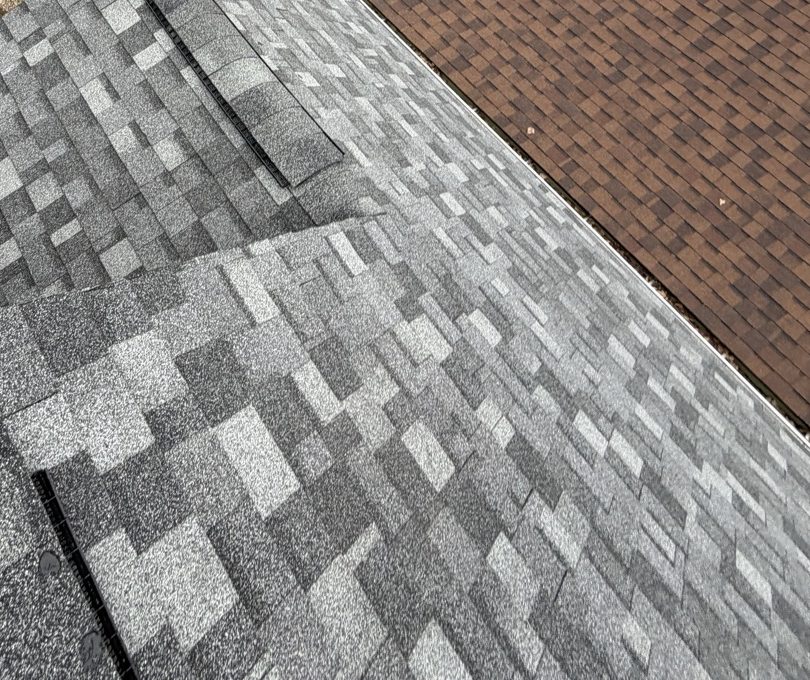
- Shingle, by manufacturer and product line. Not "architectural shingles". Keys installs Atlas and Malarkey and the proposal will say which line.
- Ventilation. The intake and the exhaust, as a package, with the count of what is being installed. Exhaust without intake makes an attic worse.
- Pitch of each section. Because the low slope sections are a different assembly and a different permit question.
- Gutters and downspouts. In scope or out. If in, the trough size, the hanger type and where the water discharges.
The commercial block
- Payment schedule. What is due when, and against what milestone. A large deposit before material is on site deserves a question.
- Debris, protection and the property. Where the dumpster goes, what protects the landscaping and the driveway, and the magnet sweep at the end.
- The change order rule. How anything unforeseen gets priced and approved. In writing, before the work, is the only version worth having.
The comparison method. Put two proposals side by side and score each of the sixteen lines as present or absent. The cheaper document is frequently the shorter one, and the difference between the two prices is often exactly the value of the lines the shorter one left out.
What a proposal must not contain
Two categories, and both are legal rather than commercial.
Anything about handling your claim
RSMo 407.725 provides that a contractor shall not represent or negotiate, or offer or advertise to represent or negotiate, on behalf of a property owner on any insurance claim connected to roof work. A proposal that offers to do that is offering something Missouri law does not permit a roofer to offer. The same statute also bars a roofing contractor from advertising or promising to absorb, rebate or discount any part of an insurance deductible, so an offer of that kind is a warning sign about everything else in the document.
What is permitted, and what Keys does, is documentation: photographs, measurements, a written scope, and attendance on site as the contractor when the adjuster comes. The claim remains yours from beginning to end.
Invented credentials
A licence number in a state that issues none. An accreditation rating the business does not hold. A manufacturer tier it has not been awarded. A warranty term stated in a proposal but absent from any document you can register. These are checkable, and the checking is worth the twenty minutes.
The proposal is the only part of a roof you get to inspect before you buy it. Read it like the product it is.
On matching, since somebody will raise it
If only part of a roof is being replaced and the new shingles will not match the old ones, be careful what you are told about the law. Missouri has no matching statute and no matching regulation for roofs. The often quoted state rule about uniform appearance governs automobile body parts, not buildings. What Missouri has is case law, notably Alessi v. Mid-Century Ins., 464 S.W.3d 529, decided by the Missouri Court of Appeals for the Eastern District in 2015, and beyond that it turns entirely on the wording of your own policy. Any contractor who tells you Missouri law requires a matching roof is telling you something that is not so.
The permit triggers behind the first four lines · How Keys produces this document
Ask Keys to look at it
Leave a name, a number and a sentence about what the roof is doing. Keys calls back, comes out, gets on the roof or puts a camera on it, and gives you a written scope with photographs and measurements. There is no charge for that and no obligation attached to it.
If the roof is open to weather right now, do not use this form. Call (314) 220-2333 and say the word emergency.
- Trades
- Roofing, gutters, downspouts
- Shingles
- Atlas and Malarkey
- Not offered
- Siding, windows, commercial
- Status
- Licensed and insured
Keys Roofing does not represent, negotiate or advertise to negotiate on any homeowner insurance claim, because RSMo 407.725 forbids a roofing contractor from doing so. Keys documents the roof and attends on site as the contractor. The claim stays yours.