Part F · water and debris
Gutters under a mature canopy
Kirkwood is a town of big old trees, and big old trees over an old roof are not a neutral condition. On most heavily shaded houses here the drainage fails before the field of shingles does, and the drainage is the cheaper half to fix.
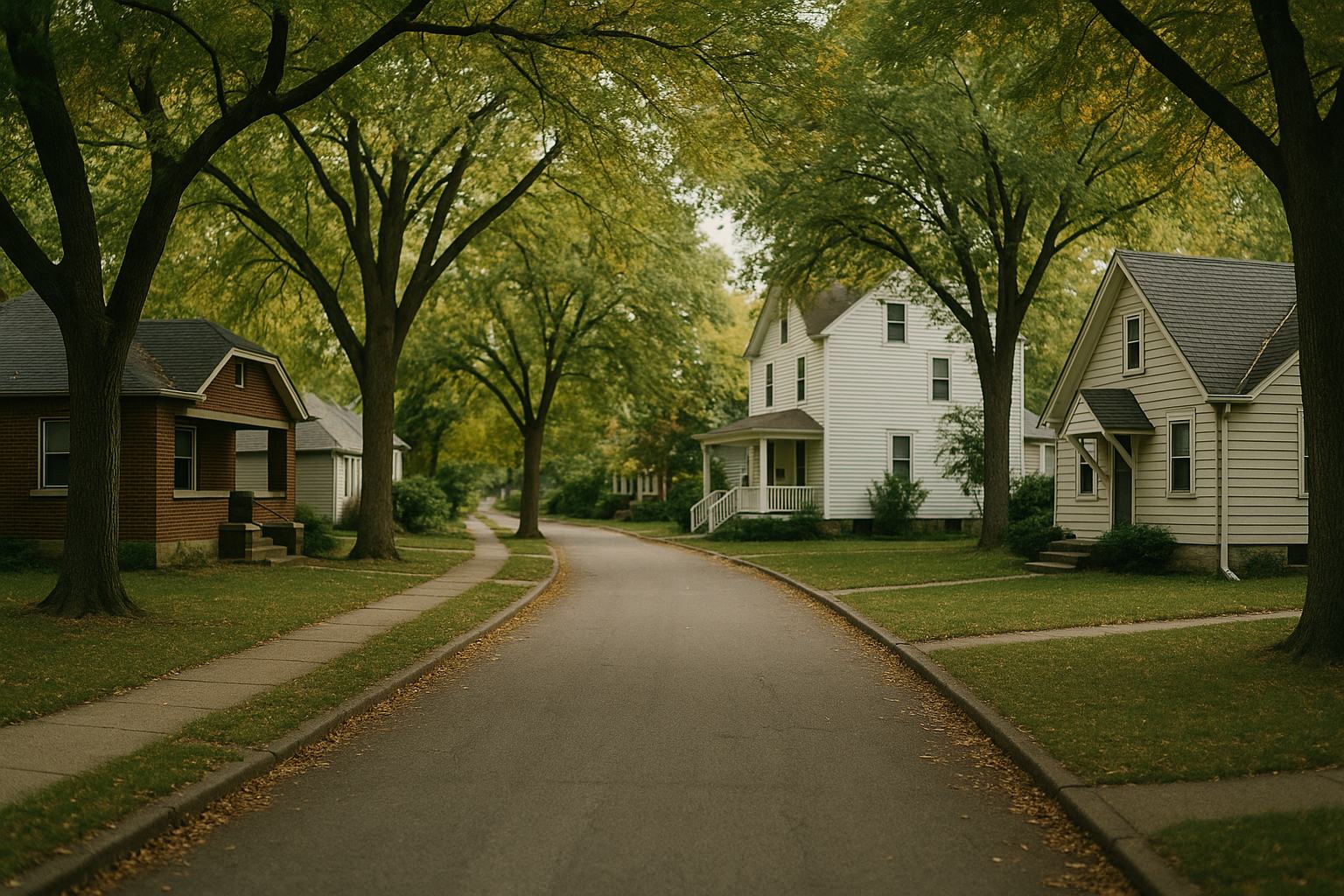
A mature canopy delivers four different loads a year
People picture autumn leaves and stop there. A mature canopy delivers four distinct loads across a year and only one of them is leaves.
- Spring. Flower parts, catkins, seed cases and the maple samaras that everyone calls helicopters. This is the fine load, and it is the one that packs into a gutter and behind a guard rather than sitting on top of it.
- Summer. Twigs and small limb drop after storms, plus the constant sift of grit and pollen. Also the season when a shaded north plane stays damp longest after rain.
- Autumn. The load everyone expects, and the easiest to see and to remove. Oak is the difficult one here because it drops late, drops heavy and its leaves are stiff enough to bridge a guard rather than blow off it.
- Winter. What did not come down in autumn, now wet, now frozen, now a solid plug at the downspout outlet exactly when the first thaw needs the gutter to work.
What the shade itself does to a shingle
Set the debris aside for a moment, because heavy tree cover changes how a roof ages even when the gutters are spotless. A plane that gets sun is dry within an hour of rain. A plane under dense canopy can stay damp all day, and a north facing plane under canopy can stay damp for most of a St. Louis winter.
Persistent damp is what feeds gloeocapsa magma, the algae responsible for the black streaking people mistake for dirt or for shingle failure. In itself the streaking is cosmetic. Moss is a different matter, because moss holds water directly against the shingle and lifts the edges of the tabs as it grows in underneath them. Once a tab is lifted, wind has something to get hold of.
Then there is simple mechanical wear. A limb that touches the roof in a wind sweeps granules off the surface in an arc, and granules are the only sunscreen an asphalt shingle has. Where you can see a bare arc on a roof you can usually stand back and find the limb that drew it.
The eave is where a shaded old roof and its gutter argue
On an older Kirkwood house the two subjects of this site meet at the eave, and they meet badly.
Start with the fascia. Gutters hang off it, and on a house with plank decking the fascia has usually been carrying spike and ferrule gutters for decades. Every spike that worked loose left a hole, every loose section became a low point, and every low point held water. Rot in the fascia is a carpentry problem that shows up as a gutter problem, and it should be quoted as carpentry rather than absorbed silently into a gutter price.
Then the ice. St. Louis winters are not severe so much as indecisive: repeated freeze and thaw rather than a long deep freeze. Meltwater runs down a warm roof, meets the cold overhang, and refreezes at the eave. Under a canopy the eave is colder than the rest of the roof for longer, so it happens more readily. Ice at the eave is not caused by the gutter, and no gutter product prevents it, but a gutter packed with a winter's worth of oak leaf will hold the ice in place rather than letting it go.
The two useful responses are both boring. Get ice and water protection installed at the eaves when the roof is replaced, which is standard on any Keys scope. And get the attic ventilated properly, because a roof deck that stays close to outdoor temperature produces far less meltwater to refreeze in the first place.
What is actually worth spending money on under a canopy
Keys does roofing, gutters and downspouts, so read the following as a contractor's view stated plainly enough that you can push back on it.
First, the tree work
Getting limbs cut back off the roof plane is the cheapest and most effective roof maintenance available in this town, and it is not sold by roofers. It reduces abrasion, it lets a plane dry, and it cuts the debris load at the source rather than catching it downstream. If you spend money on one thing, spend it here.
Second, capacity at the eave
A steep plane delivers water to the eave quickly, and a trough that cannot take the volume simply sheets over the front edge in heavy rain. That looks exactly like a blockage and often is not one. More outlets is usually a better answer than a bigger trough, and it is cheaper.
Third, guards, with the caveat attached
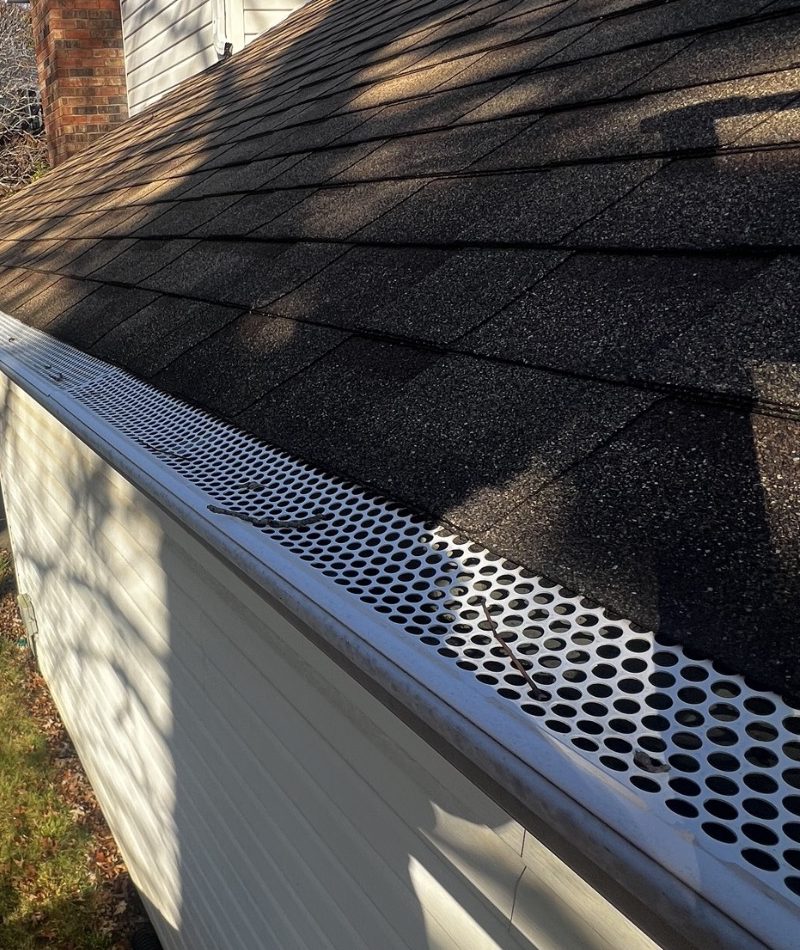
Under a canopy a guard cuts how often somebody has to be on a ladder. It does not retire the ladder. Fine spring debris packs into most designs, oak leaf is stiff enough to bridge across several of them, and the photograph above shows where the coarse stuff actually ends up: lying on top of the holes, out of the trough but still on the roof and still narrowing the opening until somebody brushes it off. Buy a guard as a reduction in frequency, and refuse to buy one sold as an end to the job.
Fourth, discharge away from the wall
Kirkwood has sloping lots and old foundations, and a downspout that empties beside the house on a slope is feeding water to the one place nobody wants it. Extensions, splash blocks or a buried line are cheap next to the alternative. This is a short paragraph because it is a short job, and it is on the list because it is the one people skip.
Six things a homeowner can see from the ground
- Streaks of dirt down the outside of a gutter, which means water has been going over the front edge.
- Plants growing in the gutter. Any plant at all. That is soil depth.
- A downspout that stays dry during a heavy rain while its neighbours run.
- Sections that sag or pull away from the fascia, especially at joints and corners.
- Black staining or moss on the north facing planes, and any limb touching the roof surface.
- Granules collecting in the gutter or at the bottom of the downspout, which on an older roof is the roof telling you how much life is left in the surface.
Ask Keys to look at it
Leave a name, a number and a sentence about what the roof is doing. Keys calls back, comes out, gets on the roof or puts a camera on it, and gives you a written scope with photographs and measurements. There is no charge for that and no obligation attached to it.
If the roof is open to weather right now, do not use this form. Call (314) 220-2333 and say the word emergency.
- Trades
- Roofing, gutters, downspouts
- Shingles
- Atlas and Malarkey
- Not offered
- Siding, windows, commercial
- Status
- Licensed and insured
Keys Roofing does not represent, negotiate or advertise to negotiate on any homeowner insurance claim, because RSMo 407.725 forbids a roofing contractor from doing so. Keys documents the roof and attends on site as the contractor. The claim stays yours.