Part E · the deck
Older houses, plank decking, and what the tear-off finds
Kirkwood housing stock is old enough that a great deal of it predates sheet decking. When the shingles come off an older house here, what is underneath is planks, and planks behave differently in every way that matters to a roof and to a price.
What plank decking is
Before plywood and oriented strand board became standard, roofs were decked with boards: wide sawn planks nailed across the rafters, usually with a deliberate gap between them. The gap was not sloppiness. Wood swells and shrinks with moisture and the space gave it somewhere to go. It also let the deck breathe from below in an era when nobody was building airtight attics.
A plank deck that has been dry for a century is a perfectly good substrate and plenty of them are still doing their job. What ages them is not time, it is perforation and water. Every roof that has ever been laid on that deck left its nails behind. Three roofs means three sets of holes through the same board, and eventually a board splits along the grain between them and will not hold a fastener.
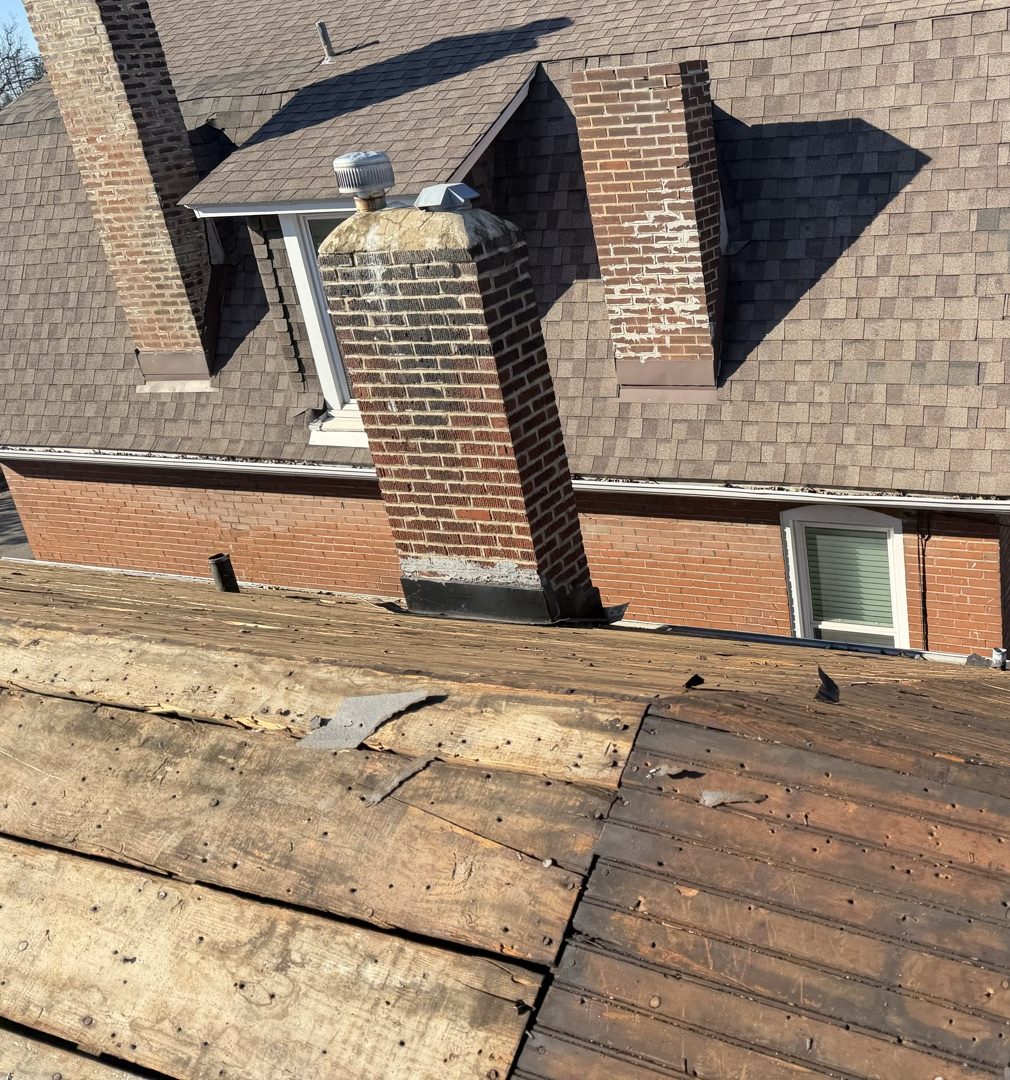
What a tear-off on an older Kirkwood house turns up
Split and perforated boards
The common one. A board that has carried three generations of nails will have a line of failure along the grain. It does not look dramatic and it will not hold a nail at the standard pattern, which means the new roof is fastened into nothing at that spot. Those boards get replaced, and the number of them is the number that moves the price.
Rot at penetrations
Water does not usually come through the middle of a field of shingles. It comes in at the things that interrupt the field: chimneys, vents, skylights, the junction where a lower roof meets a wall. On an older house with masonry chimneys, the flashing has often been patched with sealant more than once, and the deck under it has been damp for longer than anybody realised.
Layers
Two layers of shingles on an old plank deck is a common find, and occasionally three. A layover hides everything underneath it, including the condition of the deck and any rot that was present when it was laid. Tearing off to the deck is the only way to know what you have, and it is why Keys strips rather than lays over.
Ventilation that was never there
Old houses were often ventilated by accident, through gaps in the deck and an unfinished attic. Add insulation and modern air sealing below without adding intake and exhaust above, and the assembly gets hot and damp in a way it never used to. Ridge vent, box vents and adequate soffit intake are part of a roof replacement on an older house, not an upsell attached to it.
A tear-off is the only honest inspection a roof ever gets. Everything before it is inference, and everything after it is too late to renegotiate.
How this connects to the permit
Directly, and this is where the two halves of this site meet. The St. Louis County baseline puts a permit trigger at more than a quarter of the decking replaced. On a modern sheet deck that threshold is almost theoretical. On an older Kirkwood house with original plank decking it is genuinely reachable, and a homeowner should go into the job knowing that the answer might be a permit, a different schedule and a different number.
The way to make that survivable is to settle it in advance. Get the price per sheet or per board of replacement decking written into the proposal as a number. Get a stated method for how the quantity will be counted and documented, ideally with photographs. And get an answer to what happens if the quantity crosses the permit threshold mid job: who files, how long it takes, and whether the roof is dried in while it happens.
A test question. Ask a roofer what they expect to find under the shingles at your address, and why. Somebody who knows this housing stock will describe plank decking and tell you roughly how much of it usually needs replacing on a house of that age. Somebody who does not will say "we will see when we get up there" and mean it.
What goes back on
New decking where the old will not hold. Underlayment across the whole deck. Ice and water protection at the eaves and in the valleys, which matters here because the freeze and thaw cycle in a St. Louis winter is relentless rather than severe. New flashing rather than reused flashing at every penetration. Then Atlas or Malarkey shingles, and a ventilation package that matches what the attic actually needs.
Old flashing bent back into place is the single most common corner cut on an older house, because it is invisible from the ground and it saves an hour. It is also where the next leak comes from.
The sixteen lines a proposal should contain · Why the drainage fails first
Ask Keys to look at it
Leave a name, a number and a sentence about what the roof is doing. Keys calls back, comes out, gets on the roof or puts a camera on it, and gives you a written scope with photographs and measurements. There is no charge for that and no obligation attached to it.
If the roof is open to weather right now, do not use this form. Call (314) 220-2333 and say the word emergency.
- Trades
- Roofing, gutters, downspouts
- Shingles
- Atlas and Malarkey
- Not offered
- Siding, windows, commercial
- Status
- Licensed and insured
Keys Roofing does not represent, negotiate or advertise to negotiate on any homeowner insurance claim, because RSMo 407.725 forbids a roofing contractor from doing so. Keys documents the roof and attends on site as the contractor. The claim stays yours.